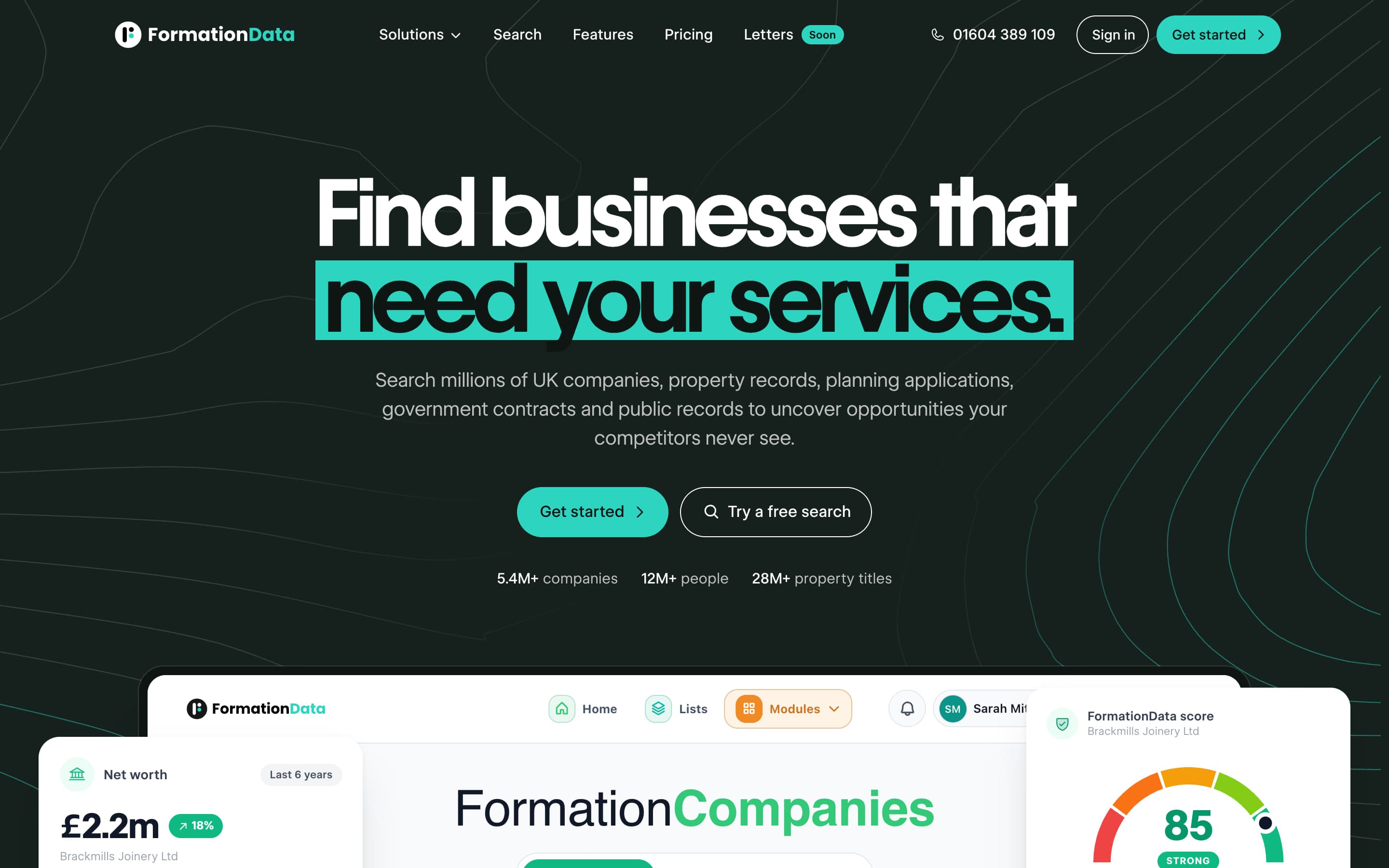
The brief
The UK publishes an extraordinary amount of public data — company formations, property records, planning applications, public tenders, probate — but it lives in scattered registers built for compliance, not discovery. The opportunities inside it go to whoever can read millions of records at once. FormationData was built to be that reader.
The engineering challenge is scale with freshness: continuously ingesting public sources, normalising records that were never designed to join, and keeping search fast across millions of rows — while presenting it all simply enough that a salesperson, not a data scientist, finds the opportunity.
What we built
- Multi-source ingestion
- Pipelines that continuously pull, clean and normalise records from disparate UK public registers into one coherent, queryable model.
- Search built for prospecting
- Fast filtered search across companies, property, planning, tenders and probate — tuned for the questions B2B teams actually ask, like who just formed, moved, or won.
- AI-assisted lead generation
- Intelligence on top of the raw records — surfacing and enriching the entries that look like opportunities, so users start from a shortlist instead of a haystack.
- A non-technical front end
- Millions of records behind an interface a busy sales team can use on day one — saved searches, clean record views, and exports that drop into existing workflows.
The stack
- Next.js
- TypeScript
- Node.js
- AI enrichment
Where it landed
FormationData is live at formationdata.co.uk, searching millions of UK public records for the businesses that subscribe to it — the kind of build where data engineering, search and product design all have to hold up at once.